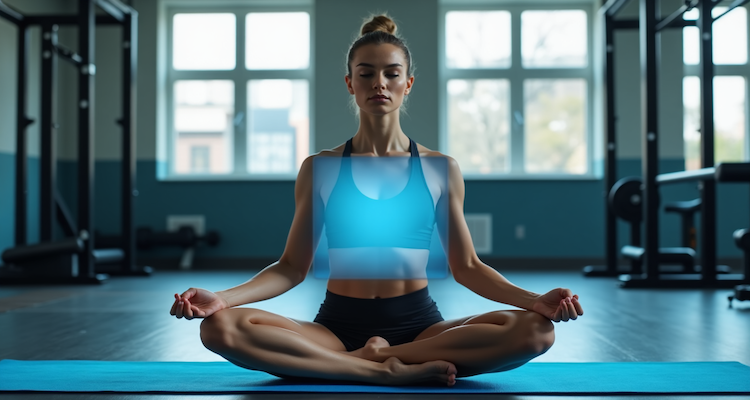
Did you know that Navy SEALs rely on box breathing to stay focused during their most intense missions? In fact, this powerful breathing technique has shown remarkable results, with a 2024 study revealing 99.2% effectiveness in improving breathing patterns.
For athletes facing high-pressure situations, box breathing offers a proven path to better performance. Research shows that athletes who practice breathing exercises improve their performance times by 5-12%, while varsity athletes report enhanced relaxation and emotional control during competitions.
Whether you're preparing for a championship game or pushing through intense training sessions, mastering the box breathing technique could be your key to maintaining composure under pressure. Let's explore how this simple yet powerful breathing method can transform your athletic performance.
Box breathing takes its name from its four equal parts ”each side of the "box" representing one phase of the breathing cycle. Also known as *sama vritti pranayama* in yoga practice, this technique follows a simple pattern: inhale for four counts, hold for four counts, exhale for four counts, and hold again for four counts [1]."Box breathing is a technique used to calm yourself down with a simple 4 second rotation of breathing in, holding your breath, breathing out, holding your breath, and repeating." Mark Divine, Former Navy SEAL Commander and Founder of SEALFIT
At its core, box breathing works by activating your parasympathetic nervous system ”often called the "rest and digest" response. This directly counteracts the sympathetic "fight or flight" response that triggers during moments of stress [1]. Research shows that controlled breathing can significantly lower cortisol levels (your primary stress hormone) and potentially reduce blood pressure [1].
When you practice box breathing, carbon dioxide temporarily builds up in your bloodstream during the breath-holding phases. This physiological response decreases your heart rate and stimulates the parasympathetic nervous system [2]. Studies demonstrate that this regulated breathing pattern improves heart rate variability, a key marker of stress resilience [3].
The U.S. Navy SEALs have adopted box breathing ”sometimes called tactical breathing”as a crucial technique for maintaining composure in life-threatening situations [4]. Former Navy SEAL Mark Divine practices it regularly: "before a workout, while standing in line, stuck in traffic and whenever else I can" to deepen concentration and slow breathing rate [5].
SEALs typically practice box breathing for approximately five minutes to reset their autonomic nervous system before and during high-stress operations [2]. This technique helps them remain calm, focused, and precise when split-second decisions matter most.
For athletes, box breathing offers numerous performance advantages. Research indicates that slow, controlled breathing enhances focus, concentration, and mental clarity ”essential elements for peak athletic performance [6]. Additionally, box breathing has been shown to:
Improve cardiovascular fitness and endurance by lowering heart rate and blood pressure [6]
Increase oxygen efficiency, enhancing overall stamina and performance [7]
Strengthen resilience to pressure situations through improved stress regulation [6]
Support faster recovery between intense physical exertions [8]
Studies published in the International Journal of Exercise Science found that deep breathing exercises improved lung function and oxygen uptake directly benefiting endurance performance [7]. Furthermore, research in the Journal of Strength and Conditioning Research showed reduced heart rate variability during exercise, indicating better stress management [7].
By incorporating box breathing into your training regimen, you gain a mental edge that complements your physical preparation, especially for high-pressure competitive situations.
Learning the proper box breathing technique starts with finding a comfortable position. Sit upright with your feet flat on the floor or lie down in a relaxed position [9]. Initially, take a few normal breaths to center yourself before beginning the structured four-part cycle.
Begin by inhaling slowly through your nose for exactly four seconds [10]. Focus on feeling the air fill your lungs completely, allowing your diaphragm to expand like a balloon [11]. This deep inhalation should be gentle and steady - not forced. If you place your hands on your belly, you'll notice it rise as you breathe in [11]. This controlled inhalation essentially draws energy into your body while establishing the rhythm of your practice [1].
Once your lungs are full, hold your breath for another four seconds [10]. Throughout this phase, maintain a relaxed state without tensing your shoulders or jaw [12]. This brief pause allows oxygen to circulate through your bloodstream and temporarily increases carbon dioxide levels, consequently stimulating your parasympathetic nervous system [13]. If holding for four seconds feels challenging at first, start with three seconds and gradually increase as you become more comfortable [1].
Afterwards, release your breath slowly through your mouth for four seconds [10]. Make your exhalation steady and complete, consciously feeling the air leave your lungs [13]. Some practitioners prefer a gentle "whoosh" sound while exhaling [14]. This phase is notably important as it releases tension and, metaphorically, expels negative energy from your body [1].
Finally, hold your breath again for four seconds before starting the next cycle [10]. This final pause completes the "box" and prepares your body for the next round [1]. During this hold, maintain your relaxed posture while keeping your lungs empty [12]. This mindful pause signals to your body that another cycle is about to begin [1].
Repeat this sequence for at least 3-5 minutes, or until you feel centered and focused [12].
Pre-competition anxiety affects even elite athletes, but box breathing offers a science-backed solution. Research shows that different emotions generate different breathing patterns - anxiety creates short, fast, shallow breaths, while calmness produces regular, deep, slow breathing [15]. By controlling your breathing, you actively shift your emotional state.
For optimal pre-competition mental preparation, follow this 5-minute box breathing routine:
Begin Gently: Start with 2-second counts for each phase (inhale, hold, exhale, hold), gradually increasing duration as you become comfortable [15][16]
Build Your Practice: After 1-2 minutes, try extending to 4-second counts if it feels natural
Focus Enhancement: During inhales, silently think "energy in" and during exhales "fatigue out" to reinforce the mental benefits [17]
Complete the Circuit: Continue for the full 5 minutes, allowing your body to settle into a parasympathetic state [18]
This protocol works most effectively when practiced regularly before high-stress situations arise [1]. According to research, regular box breathing creates "pockets of peace" throughout your day, making the technique more accessible when you need it most under competitive pressure [1].
Pre-competition nervousness is not only normal but potentially beneficial—it can sharpen focus and provide a competitive edge [15]. However, unchecked anxiety can undermine performance.
Box breathing gives you a practical tool to regulate this anxiety. When practiced before important competitions, it activates your parasympathetic nervous system, countering the high sympathetic activity intrinsic to stress [19]. Moreover, extending your exhales slightly longer than your inhales provides additional calming effects when nervousness peaks [15].
For maximum effectiveness before big events, practice box breathing during daily training sessions so it becomes automatic during competition [17]. Consequently, your brain and body develop a conditioned response to this rhythmic breathing pattern, creating what researchers describe as a "predictable rhythm in a world that's often unpredictable" [1].
When competition intensifies, box breathing becomes your mental anchor. Unlike pre-game routines, in-competition breathing requires adaptability and quick execution to maintain peak performance when it matters most."When you breath-hold, that increases your carbon dioxide level temporarily. And when you increase your carbon dioxide level in your bloodstream, that decreases your heart rate. And so it helps to bring on that parasympathetic physiology online as well." Ni-Cheng Liang, Pulmonologist and Director of Pulmonary Integrative Medicine at Coastal Pulmonary Associates
Between points, plays, or during brief timeouts, implement these rapid reset techniques:
Four-second mini-cycle: Perform one complete box breathing cycle when you have 16 seconds between plays [15]
Extended exhale focus: When nerves resurface during competition, lengthen your exhale phase to quickly calm your system [15]
Silently count: Count the beats during your breath cycle to act as a form of meditation, keeping you grounded in the present moment [20]
Practice these techniques consistently outside competition so they become automatic when needed. Studies show that working on box breathing during calm periods improves your ability to use it effectively during high-stress situations [21].
Each sport requires specific breathing adaptations. For swimmers, box breathing must coordinate with arm strokes since you "can't simply breathe at will" as in other sports [20]. For team sports with intermittent play, use natural breaks between points or during substitutions.
Basketball players might use a single box breath cycle during free throws, whereas tennis players can implement it between points. The key lies in finding natural rhythms within your sport where brief mental resets are possible.
As pressure intensifies, box breathing serves as your mental stabilizer. The technique effectively counteracts the rapid, shallow breathing pattern that typically accompanies performance anxiety [1].
Recognize when your breathing becomes shallow—this signals your body is entering fight-or-flight mode. Immediately shift to box breathing, even if you can only manage a modified version with shorter counts.
Advanced athletes often practice extending their exhale to twice the length of their inhale (1:2 ratio) during particularly stressful moments [6], which provides additional calming benefits while maintaining competitive readiness.
Box breathing stands as a proven technique that transforms athletic performance through better focus and stress management. Research consistently shows its effectiveness, from Navy SEALs maintaining composure in critical situations to athletes achieving peak performance during competitions.
Mastering this four-part breathing technique offers clear advantages - reduced anxiety, enhanced concentration, and improved physical performance. Athletes who regularly practice box breathing report better emotional control and increased confidence during high-pressure situations.
Remember that box breathing becomes most effective through consistent practice. Start with the basic technique during training sessions, then gradually apply it during competitions. Though simple, this powerful tool might become your secret weapon for maintaining composure when victory hangs in the balance.
Q1. How does box breathing improve athletic performance? Box breathing enhances athletic performance by activating the parasympathetic nervous system, which reduces stress and anxiety. It improves focus, concentration, and mental clarity while also enhancing cardiovascular fitness, oxygen efficiency, and recovery between intense physical exertions.
Q2. Can box breathing be used during competition? Yes, box breathing can be effectively used during competition. Athletes can perform quick reset techniques between plays, such as a four-second mini-cycle or focusing on extended exhales. The key is to practice consistently so it becomes automatic when needed in high-pressure situations.
Q3. How long should I practice box breathing for optimal results? For optimal results, aim to practice box breathing for at least 3-5 minutes at a time. A 5-minute warm-up protocol before competitions can be particularly effective. Regular practice during daily training sessions helps make the technique more accessible when you need it most under competitive pressure.
Q4. Is box breathing suitable for all types of sports? Box breathing can be adapted for different sports, but the application may vary. For example, swimmers need to coordinate it with their arm strokes, while team sport athletes can use natural breaks between points or during substitutions. The key is to find natural rhythms within your sport where brief mental resets are possible.
Q5. How does box breathing compare to other relaxation techniques for athletes? Box breathing stands out as a highly effective relaxation technique for athletes due to its simplicity and versatility. Unlike some methods that require specific environments or equipment, box breathing can be practiced anywhere, anytime. It's particularly valued for its ability to quickly shift the body from a stress response to a more calm and focused state, making it ideal for use before and during competitions.
[1] - https://www.calm.com/blog/box-breathing
[2] - https://www.medicinenet.com/why_do_navy_seals_use_box_breathing/article.htm
[3] - https://integrativehealthandrehab.com/lifestyle/box-breathing-navy-seals/
[4] - Balban, M. Y., Neri, E., Kogon, M. M., Weed, L., Nouriani, B., Jo, B., Holl, G., Zeitzer, J. M., Spiegel, D., & Huberman, A. D. (2023). Brief structured respiration practices enhance mood and reduce physiological arousal. Cell reports. Medicine, 4(1), 100895. https://doi.org/10.1016/j.xcrm.2022.100895
[5] - https://www.deseret.com/lifestyle/2024/07/30/navy-seal-box-breathing/
[6] - https://www.redbull.com/gb-en/breathing-techniques-for-sport
[7] - https://fitcure.co.uk/box-breathing-a-powerful-technique-for-better-health-and-performance/
[8] - https://www.breatheology.com/breathwork-in-athletic-performance/
[9] - https://www.medicalnewstoday.com/articles/321805
[10] - https://www.webmd.com/balance/what-is-box-breathing
[11] - https://www.bhf.org.uk/informationsupport/heart-matters-magazine/wellbeing/breathing-exercises
[12] - https://www.breathworks.studio/ignite/box-breathing-for-sports-performance
[13] - https://www.healthline.com/health/copd/box-breathing/
[14] - https://www.medicalnewstoday.com/articles/324417
[15] - https://blayze.io/blog/general/the-science-of-breathing-for-athletes
[16] - https://www.teamsnap.com/blog/general-sports/pregame-breathing-exercises
[17] - https://www.alstonforathletes.org/post/technique-to-face-performance-anxiety-box-breathing
[18] - https://sleep.me/post/box-breathing-for-mindfulness-5?srsltid=AfmBOop9t4bU2XwNVzss4Ms4EWg_NnRh5-UVLmo5WLeoSeWcvNHaXmFC
[19] - Bentley, T. G. K., D'Andrea-Penna, G., Rakic, M., Arce, N., LaFaille, M., Berman, R., Cooley, K., & Sprimont, P. (2023). Breathing Practices for Stress and Anxiety Reduction: Conceptual Framework of Implementation Guidelines Based on a Systematic Review of the Published Literature. Brain sciences, 13(12), 1612. https://doi.org/10.3390/brainsci13121612
[20] - https://www.nike.com/gb/a/how-breath-improves-performance
[21] - https://health.clevelandclinic.org/box-breathing-benefits