Benefits of Imagery
The beneficial use of imagery in performance environments has been well documented (e.g., Vealey & Greenleaf, 1998), and supported by compelling research evidence (e.g., Feltz & Landers, 1983; Martin, Mortiz & Hall, 1999).
What is Imagery?
Imagery is commonly defined as “… quasi-sensory and quasi-perceptual experiences of which we are self-consciously aware and which exist for us in the absence of those stimulus conditions that are known to produce their genuine sensory or perceptual counterparts” (Richardson, 1969; pp. 2-3). Put simply it is where we experience sensations, such as, thoughts, feelings, sights, sounds, bodily movements and so on, in the absence of the stimulus which causes those sensations. So a parachutist can imagine the physical sensation of jumping out of a plane, and the emotions associated with it without actually jumping out of the plane.
What can Imagery be used for?
Past research by Paivio (1985) has identified that imagery serves both cognitive and motivational functions. Using Paivio’s original taxonomy of imagery function as a basis, Hall, Mack, Paivio and Hausenblas (1998) identified five functions of imagery in the development of the Sport Imagery Questionnaire, which has been incorporated by Martin, et al. (1999) in to their conceptual model of imagery use in sport settings. The five functions of imagery include, motivational-specific, motivational general-mastery, motivational general-arousal, cognitive specific, and finally, cognitive general. A description of each imagery function is outlined below:
- Motivational-Specific (MS) imagery represents specific goals and goal-oriented behaviours such as imagining receiving a gold medal at an Olympic Games.
- Motivational General-Mastery (MG-M) imagery refers to effective coping and mastery of challenging situations. For example, imagining feeling confident while climbing a difficult rock face or being focused prior to a crucial penalty kick in a rugby match.
- Motivational General-Arousal (MG-A) imagery focuses on feelings such as relaxation, stress, arousal and anxiety in conjunction with sport competition. For example, imagining feeling anxious as you take a crucial penalty kick in a soccer match, or feelings of excitement as you take the field for your first-ever international match in cricket.
- Cognitive Specific (CS) imagery refers to specific sport skills, such as, executing a perfect golf drive or a vault in gymnastics.
- Cognitive General (CG) imagery refers to competitive strategies. For example, a point guard imagining the execution of a full court press in basketball or a field hockey player imagining a particular short-corner play.
Martin et al. (1999) proposed that the five types of imagery are functionally orthogonal. That is, while an athlete may choose to use only one type of imagery it is also possible for him or her to experience two or more types simultaneously. Imagery can be used for a variety of purposes, but notably, it is effective for learning new skills (Feltz and Lander, 1983) regulating emotions (e.g., Hecker & Kaczor, 1988), enhancing self-confidence (Callow, Hardy, & Hall, 2001), and promoting coping under stress (e.g., Vadocz, Hall, & Moritz, 1997). For reviews, see Martin, Moritz, & Hall, 1999; Cumming & Ramsey, 2008).
Using Imagery
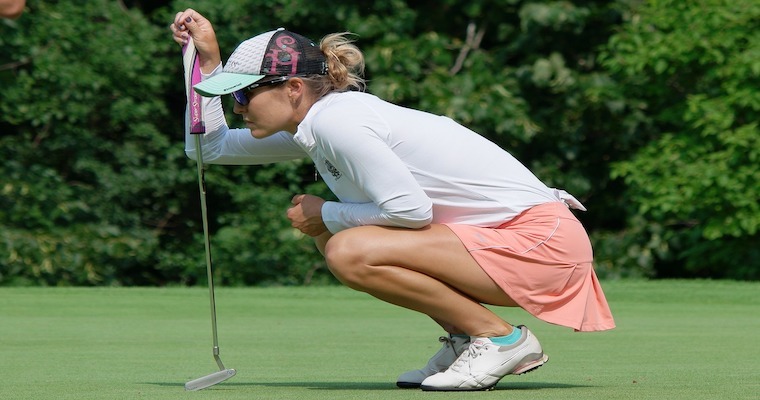
There are a number of factors to consider when using imagery. Imagery can be done from within your body (as you normally see the world) or from outside your body (as if you were watching yourself on TV). The style an individual chooses depends on personal preference; however, imagery is not only about seeing events in the mind’s eye, it involves all of the senses to make re-creating the event as real as possible. To illustrate, a golfer imagining a successful pitch would feel the correct movements, feel and hear the ball come off the club face, see the ball travel through the air, see it pitch on the green, and hear it hit the flag and drop into the hole. Ideally, as many of the senses should be used to make the imagery as realistic as possible but this will depend on your preference. Some people find it difficult to ‘see’ what is happening but are able to recreate the movement easily and vice versa. The ‘PETTLEP’ approach to imagery (Holmes & Collins, 2001) proposes a seven-point checklist that includes: physical, environmental, task, timing, learning, emotional, and perspective elements of imagery in order to enhance the efficacy of it use. When using imagery it is important to make sure the image occurs in ‘real time’ - the same speed it happens in real life. It is also important that that the imagery is positive – something the person wants to happen and not something to avoid. Finally, like all skills (mental and physical) the more imagery is practiced the better the skill is developed. May psychologists suggest to practice a little and often. For example, spend 3 to 5 minutes a day imagining and become comfortable using imagery in a low stress situation, first. For example, in a quiet comfortable room before it is transferred to more stressful settings.
References
Callow, N., Hardy, L., & Hall, C. R. (2001). The effect of a motivational general-mastery imagery intervention on the sport confidence of four high level junior badminton players. Research Quarterly for Sport & Exercise Psychology, 72, 389–400.
Cumming, J., & Ramsey, R. (2008). Imagery interventions in sport. In S. Mellalieu, & S. Hanton (Eds.), Advances in applied sport psychology: A review (pp. 5–36). London: Routledge.
Feltz, D. L., & Landers, D. M. (1983). The effects of mental practice on motor skill learning and performance: A meta-analysis. Journal of Sport Psychology, 5, 25-57.
Hall, C., Mack, D. E., Paivio, A., & Hausenblas, H. (1998). Imagery use by athletes: development of the Sport Imagery Questionnaire. International Journal of Sport Psychology, 23, 1-17.
Hecker, J. E., & Kaczor, L. M. (1988). Application of imagery theory to sport psychology. Journal of Sport & Exercise Psychology, 10, 363–373.
Holmes, P. S., & Collins, D. J. (2001). The PETTLEP approach to motor imagery: A functional equivalence model for sport psychologists. Journal of Applied Sport Psychology, 13, 60-83.
Martin, K. A., Moritz, S. E., & Hall, C. R. (1999). Imagery use in sport: A literature review and applied model. The Sport Psychologist, 13, 245-268.
Maynard, I. W., Hemmings, B., & Warwick-Evans, L. (1995). The effects of a somatic intervention strategy on competitive state anxiety and performance in semiprofessional soccer players. The Sport Psychologist, 9, 51-64.
Paivio, A. (1985). Cognitive and motivational functions of imagery in human performance. Canadian Journal of Applied Sport Sciences, 10, 22-28.
Prapavessis, H., Grove, J. R., McNair, P. J., & Cable, N. T. (1992). Self-regulation training, state anxiety, and sport performance: A psychophysiological case study. The Sport Psychologist, 6, 213-229.
Richardson, A. (1969). Mental imagery. New York: Springer.
Vadocz, E. A., Hall, C. R., & Moritz, S. E. (1997). The relationship between competitive anxiety and imagery use. Journal of Applied Sport Psychology, 9, 241–253.
Vealey, R. S., & Greenleaf, C. A. (1998). Seeing is believing: Understanding and Using Imagery in Sport. In J. M. Williams (Ed.), Applied Sport Psychology: Personal growth to peak performance, (237-269). Mountain View, CA: Mayfield (3rd Ed.).